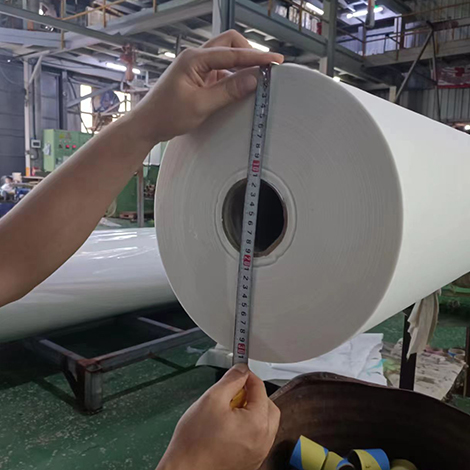
La adición de un concentrado de carbonato de calcio al proceso de producción de telas no tejidas spunbond de PP (polipropileno) ofrece mayores ventajas en cuanto a precio, proceso de fabricación, costo de producción, características físicas, etc. La expansión de las áreas de aplicación y el desarrollo sostenible de las telas no tejidas spunbond de PP, junto con el ahorro energético y la reducción de emisiones, son tendencias inevitables en el desarrollo de la industria de telas no tejidas spunbond. ¡Hoy les presentaremos el proceso y la aplicación del carbonato de calcio en telas no tejidas!
Proceso de fabricación de carbonato de calcio en tejido no tejido spunbond de PP
La materia prima utilizada en la producción de tejido no tejido spunbond de PP es polipropileno de alto índice de fluidez, mezclado uniformemente con un masterbatch a base de carbonato de calcio. Este entra en la extrusora de tornillo desde la tolva para su fusión por extrusión, luego pasa por el prefiltro continuo y finalmente llega a la caja de hilado. El material fundido entra en el cabezal de hilado a través de una bomba dosificadora, que lo transporta con precisión a la placa de hilado, donde forma un flujo continuo y fino a través de los orificios de hilado, es decir, las fibras primarias. Las fibras recién formadas se enfrían mediante aire frío repentino y se estiran con el flujo de aire para formar largos haces. El rodillo de hilado mueve el haz de filamentos largos de un lado a otro y lo deposita uniformemente sobre la cortina de malla móvil para formar una red de fibras.
¿Por qué elegir carbonato de calcio como masterbatch de relleno?
El carbonato de calcio es un producto químico inorgánico de suma importancia, ampliamente utilizado en industrias como la del plástico, el caucho, los recubrimientos y la fabricación de papel. Las características de varios rellenos comúnmente utilizados en la industria son las siguientes:
Carbonato de calcio: El objetivo de añadir un concentrado de relleno a la tela no tejida spunbond es reducir costes. Gracias a la experiencia en la modificación de las funciones de la resina plástica y la reducción de costes, resulta ser el más económico y fácilmente disponible, con una apariencia de polvo blanco e inodoro. Su densidad relativa es de 2,71, su índice de refracción es de 1,65 y su dureza Mohs es de 3.
Suelo antiguo: fácil de dispersar, relativamente más caro que el carbonato de calcio, también de aspecto blanco, con una densidad relativa de 2,6 y un índice de refracción de 1,56.
Talco en polvo: fácil de dispersar, con cierta lubricidad para los equipos durante el procesamiento, y es un polvo blanco con cristales sólidos. Busco una densidad entre 2,7 y 2,8, pero el precio es relativamente elevado.
Polvo de mica: Su blancura relativa es menor. Debido a su naturaleza no tóxica, el polvo de mica se puede utilizar en productos en contacto con alimentos con una densidad relativa entre 2,8 y 3,0, un índice de refracción de 1,59 y una dureza Mohs de 3.
Wollastonita: con una densidad relativa de 2,9, un índice de refracción de 1,63 y una dureza Mohs de 4,5, su mayor ventaja es que no absorbe la humedad y tiene poco efecto sobre el concentrado de color.
Por lo tanto, en el proceso de producción de telas no tejidas, generalmente se elige el carbonato de calcio como relleno principal, y se agrega una pequeña cantidad de caolín o wollastonita para mejorar la dispersión y la transparencia durante el proceso. Por lo general, se elige carbonato de calcio con un tamaño de malla de 1500 o superior, y no se recomienda que sea demasiado fino, ya que un tamaño de malla excesivo resulta costoso. Además, los polvos ultrafinos generalmente no se dispersan bien.
Método de llenado del material de llenado
Sin modificar el equipo de producción ni las condiciones del proceso, el material de relleno se añade a la tolva de alimentación del masterbatch de color, pero la proporción de adición también se verá limitada. Algunos fabricantes añaden una tolva y un alimentador más grandes específicamente para añadir rellenos. La cantidad máxima de material granular añadido es de aproximadamente el 20%, y la cantidad de polvo añadido es de aproximadamente el 8%. Actualmente, algunos fabricantes han añadido una o varias máquinas mezcladoras para mezclar estos materiales de manera uniforme y alimentarlos manualmente a la tolva, lo que resulta en una mayor uniformidad. La proporción de adición puede alcanzar hasta el 30%, y el polvo también puede llegar a aproximadamente el 15%. Algunos fabricantes lo mezclan de manera uniforme y luego lo introducen en la tolva, pero la uniformidad es relativamente baja, aunque también se puede añadir entre el 20% y el 30%.
Debido a la reducción de costos del masterbatch de llenado, cuanto mayor sea la concentración de relleno en el masterbatch, menor será el costo y menor la proporción de usuarios que lo añaden. Por el contrario, cuanto menor sea la concentración, mayor será el costo y mayor la proporción de usuarios que lo añaden. Además, el masterbatch funcional de producción no debe rellenarse con masterbatch para evitar que se vea afectada su funcionalidad.
Aunque el uso de carbonato de calcio como masterbatch de relleno puede aumentar el rendimiento de los tejidos no tejidos y reducir los costos, los tejidos no tejidos producidos por este método tienen poca resistencia al desgarro y son muy susceptibles al desgaste durante su uso. Para mejorar este inconveniente,
Las precauciones para el uso del masterbatch de relleno son las siguientes:
1. El masterbatch funcional de producción no debe mezclarse con masterbatch de carga para evitar que su funcionalidad se vea afectada. Las cargas tienen un efecto inhibidor sobre algunos agentes funcionales, pero no afectan al color.
2. El uso de masterbatch de relleno tiene un cierto efecto de degradación, lo que afecta la vida útil de los tejidos no tejidos, especialmente de aquellos producidos a partir de materiales en polvo.
3. Los estándares de prueba para este producto incluyen:
Norma GW∝-2000 para el control de la incineración de residuos sólidos urbanos.
GB 3682 Tasa de flujo de fusión
Q/TNGM 01-2006 Método de ensayo para el índice de aumento de presión del masterbatch de color de fibra de polipropileno
GB 1033 Método de ensayo para la densidad del masterbatch de relleno
Prueba de blancura GB 2913
4. El masterbatch de llenado no se conserva bien al aire libre durante mucho tiempo, y su alta capacidad de absorción de humedad puede afectar su hilabilidad. Si se utiliza de forma irregular, se puede optar por el envasado al vacío.