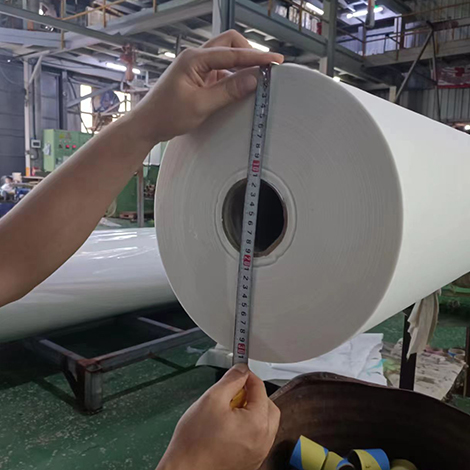
Has elegido la tela adecuada. El gramaje adecuado. El ancho adecuado. El color adecuado. Pero hay un detalle más que importa, y que a menudo se pasa por alto: ¿Qué tamaño de tubo central deben tener sus rollos?
Puede parecer un detalle insignificante, pero elegir el tamaño incorrecto del núcleo puede afectar los costos de envío, la eficiencia de la producción e incluso la calidad de la tela.
Aquí encontrará todo lo que necesita saber para seleccionar el tubo central adecuado para su tejido no tejido spunbond de PP.
¿Qué es un tubo con núcleo enrollado?
Un tubo de núcleo de rollo (también llamado núcleo de papel o núcleo de cartón) es el centro cilíndrico Alrededor del cual se enrolla la tela no tejida. Proporciona soporte estructural al rollo y permite que la tela se monte en equipos de dispensación o conversión.
Los tubos de núcleo suelen estar hechos de papel kraft de alta densidad — lo suficientemente resistente como para soportar el peso del rollo durante el bobinado, la manipulación y el envío.
Los tres tamaños estándar de núcleo
En la industria de los no tejidos, existen tres diámetros interiores estándar que debes conocer:
Tamaño del núcleoDiámetro interior (DI)Cómo se produce
| núcleo de 3 pulgadas | 76,2 mm | núcleo inicial estándar — directamente de la línea de producción |
| núcleo de 2 pulgadas | 50,8 mm | Requiere rebobinar (convertido de 3 pulgadas) |
| núcleo de 1,5 pulgadas | 38,1 mm | Requiere rebobinar (convertido de 3 pulgadas) |
Núcleo de 3 pulgadas: el estándar de la industria
El núcleo de 3 pulgadas es el tamaño más común en la industria de los no tejidos. En Heng Hua Nonwoven, como la mayoría de los fabricantes, Nuestra línea de producción fabrica tela directamente sobre núcleos de 3 pulgadas.Este es el núcleo "inicial" o "primario": sin pasos adicionales, sin manipulación adicional, directamente desde la línea.
¿Por qué 3 pulgadas es el estándar?
- Directamente compatible con la mayoría de las líneas de producción de telas no tejidas.
- Se adapta a la mayoría de los equipos de conversión (fabricación de bolsas, máquinas de mascarillas, líneas de corte).
- Lo suficientemente resistente para soportar pesos de rollos típicos.
- Rentable: no requiere ningún paso de rebobinado adicional.
- Mínimo riesgo de problemas de calidad
Núcleos de 2 y 1,5 pulgadas: requieren rebobinado.
Algunos clientes solicitan núcleos más pequeños —de 2 pulgadas o 1,5 pulgadas— para reducir el tamaño del rollo. Pero a diferencia de los de 3 pulgadas, estos son no se produce directamente en la línea de producción principal. Requieren un proceso de rebobinado (también llamado "corte y rebobinado" o simplemente "rebobinado").
En el rebobinado, un rollo de núcleo grande de 3 pulgadas se desenrolla y luego se vuelve a enrollar en un núcleo más pequeño. Esto añade un paso de producción adicional, lo que significa:
- Mayor costo — mano de obra adicional y tiempo de máquina
- Plazo de entrega más largo — rebobinar lleva tiempo
- Riesgo potencial para la calidad — La tela se manipula dos veces
¿Por qué elegir un núcleo más pequeño? La ventaja del contenedor.
La principal razón por la que los clientes solicitan núcleos de 2 pulgadas o 1,5 pulgadas es eficiencia de envío.
Un diámetro de núcleo más pequeño significa que El diámetro total del rollo es menor. para la misma longitud de rollo. Incluso un reducción de 1–2 cm en el diámetro del rollo puede marcar una diferencia significativa; podría significar que se ajuste una fila extra de rollos cuando se colocan horizontalmente dentro de un contenedor de envío.
En una carga completa de contenedor, esa fila adicional se traduce en: ahorros reales en fletesPara los compradores de grandes volúmenes, esta es una razón de peso para considerar núcleos más pequeños.
Regla crítica 1: Límites GSM para el rebobinado
Importante: Para telas de 40 g/m² o más ligero, nosotros No se recomienda rebobinar.. Para 30 g/m² o menos, Se desaconseja encarecidamente rebobinar..
¿Por qué? Porque la tela no tejida ligera es fino y delicadoEl proceso de rebobinado somete la tela a tensión, estiramiento y manipulación mecánica. En el caso de telas ligeras, esto puede provocar:
- Aclareo — la tela se estira y se vuelve aún más ligera, cambiando el GSM.
- Deformación — encogimiento del ancho o bordes irregulares
- Daños superficiales — formación de bolitas, abrasión o alteración de las fibras
- Pérdida de uniformidad — GSM inconsistente en todo el rollo
Regla general:
- 30 g/m² o menos: Es IMPRESCINDIBLE usar un núcleo de 3 pulgadas. Rebobinar dañará la tela.
- 40 g/m²: Retroceder es arriesgado; evalúelo con cuidado.
- 50 g/m² o superior: El rebobinado suele ser seguro con un control de tensión adecuado.
Regla crítica 2: Límites de ancho para el rebobinado
Rebobinar no se trata solo de GSM — El ancho de la tela también importa..
Nuestras máquinas rebobinadoras tienen capacidades de ancho específicas. Si un rollo es demasiado estrechoNo se puede rebobinar correctamente porque la tela se desplazará, se moverá o se enrollará de forma desigual.
Especificaciones de nuestra máquina rebobinadora:
- Rebobinador 1: 1,6 metros Capacidad de ancho (160 cm)
- Rebobinador 2: 2,4 metros Capacidad de ancho (240 cm)
Límites de ancho para el rebobinado:
Ancho de la tela ¿Es posible rebobinarla? Notas
| ≥ 140 cm (1,4 m) | Sí | Rebobinado estable, buena alineación de bordes. |
| 130 cm (1,3 m) o menos | No | La tela se desplaza, se enrolla de forma desigual, los bordes se tuercen. |
| 52 cm (0,52 m) — demasiado estrecho | No | No se puede rebobinar en nuestro equipo. |
Recordar: Los rollos de 1,5 metros y 1,4 metros se pueden rebobinar. 1,3 metros o menos no — la tela se moverá y se retorcerá.
Ejemplos de especificaciones del mundo real
Aquí tienes dos ejemplos que te ayudarán a comprender cuándo funciona la función de rebobinado y cuándo no:
✅ Ejemplo 1 — Rebobinado correcto
Especificación: 70 g/m² × 200 cm de ancho × 50 m de largo
Núcleo solicitado: 2 pulgadas
Veredicto: ✅ OK
Por qué: El gramaje de 70 g/m² es suficiente para soportar la tensión de rebobinado. El ancho de 200 cm se ajusta perfectamente a la capacidad de la rebobinadora de 2,4 m. La tela es estable y la longitud de 50 m es manejable.
✅ Ejemplo 2 — Rebobinado correcto
Especificación: 50 g/m² × 150 cm de ancho × 100 m de largo
Núcleo solicitado: 1,5 pulgadas
Veredicto: ✅ OK
Por qué: 50 g/m² supera el umbral de 40 g/m². El ancho de 150 cm supera el mínimo de 130 cm. El núcleo de 1,5 pulgadas es factible con un control preciso de la tensión.
❌ Ejemplo 3: Rebobinar NO está bien
Especificación: 25 g/m² × 52 cm de ancho × 200 m de largo
Núcleo solicitado: 2 pulgadas
Veredicto: ❌ NO ESTÁ BIEN
Por qué: 25 g/m² está por debajo de 40 g/m²; al rebobinar, la tela se estirará y se adelgazará. 52 cm de ancho está muy por debajo del mínimo de 130 cm; la tela se deformará y se enrollará torcida. Esta especificación debe mantenerse en un núcleo de 3 pulgadas.
Guía de decisión: ¿Se puede modificar su especificación?
Utilice esta lista de verificación rápida para determinar si su especificación es adecuada para rebobinar a un núcleo más pequeño:
Requisito Debe Ser Por qué
| GSM (peso de la tela) | ≥ 50 g/m² (idealmente)
> 40 g/m² (mínimo) | Por debajo de 40 g/m², la tela se estira y se adelgaza durante el rebobinado. |
| Ancho de la tela | ≥ 140 cm | Por debajo de los 130 cm, la tela se desplaza y el viento la arrastra de forma desigual. |
| Longitud del rollo | Depende del GSM y del ancho. | Los rollos más largos requieren un control de tensión más cuidadoso. |
El grosor de la pared del núcleo también importa.
Independientemente del diámetro interior, el espesor de pared El grosor del núcleo determina su resistencia a la compresión. Un núcleo delgado se aplastará bajo un peso excesivo al ser laminado o al ser sujeto por un mandril hidráulico.
Tamaño del núcleoPared estándarPared de servicio pesado
| núcleo de 3 pulgadas | 5–6 mm | 8–10 mm |
| núcleo de 2 pulgadas | 5–6 mm | 8–10 mm |
| núcleo de 1,5 pulgadas | 4–5 mm | 6–8 mm |
Para cualquier tamaño de núcleo, si el peso del rollo supera 100–120 kgRecomendamos actualizar a una pared de alta resistencia.
Resumen: Flujo de decisión sobre el tamaño del núcleo
Guía de decisión rápida:
- ¿Su tejido es de 40 g/m² o más ligero? → Debe usarse núcleo de 3 pulgadasNo se permite rebobinar.
- ¿El ancho de su tela es de 130 cm o menor? → Debe usarse núcleo de 3 pulgadasNo se puede rebobinar.
- ¿Su tejido tiene un gramaje superior a 50 g/m² y un ancho superior a 140 cm? → Puedes elegir 2 pulgadas o 1,5 pulgadas mediante rebobinado.
- ¿Necesitas la máxima eficiencia de tus contenedores? → Elija el núcleo más pequeño que cumpla con los criterios anteriores.
En resumen
Elegir el tamaño correcto del tubo del núcleo es una acto de equilibrio entre la eficiencia del envío y la calidad de la tela, con las limitaciones físicas de la maquinaria de por medio.
Las reglas son sencillas:
- 3 pulgadas es el núcleo inicial estándar: siempre funciona, el menor costo, el menor riesgo.
- 2 pulgadas y 1,5 pulgadas Requiere rebobinado: coste y plazo de entrega adicionales, pero mejora la utilización del contenedor.
- 40 g/m² o menos — NO rebobine. Manténgase en 3 pulgadas.
- 130 cm de ancho o menos — NO rebobine. Manténgase en 3 pulgadas.
- 50 g/m²+ y 140 cm+ — Es posible rebobinar; elija 2 pulgadas o 1,5 pulgadas para ahorrar en contenedores.
Si no está seguro de si su especificación se puede rebobinar, Solo pregúntanosComprobaremos el gramaje, el ancho y la longitud del cable, comparándolos con nuestra capacidad de rebobinado, y le daremos una recomendación clara.
¿Busca un proveedor fiable de rollos de tela no tejida spunbond de PP? Ofrecemos núcleos de 3 pulgadas directamente de la producción, y podemos proporcionar núcleos de 2 o 1,5 pulgadas mediante rebobinado para las especificaciones adecuadas.
Contáctanos para obtener muestras o un presupuesto. – Busquemos el tamaño de núcleo adecuado para su producto.